
The Lessons for Thriving in an Unpredictable Future
What should we teach kids about the future when we barely understand it ourselves?

Great teachers used to be rare. If you were lucky, you had one or two who didn’t just teach facts but reshaped how you saw the world.
That used to be my aim back in my teaching days. For some students, I may have succeeded. With others, I probably failed—perhaps for lack of knowledge, patience, empathy or maybe I simply wasn’t the right fit for that particular student at that particular time.
Enter Large Language Models — what most people now just call “AI”. Suddenly a teacher with seemingly unlimited knowledge and patience might be just a few clicks away, ready to conform to any teaching style the student might best respond to.
When good answers are only a click away, asking the right questions becomes the most important skill anyone can learn. And that’s where we—parents, teachers, mentors, even colleagues—still play a powerful role: helping young people figure out what’s worth learning, how to apply it wisely, and what it all means in context.
Not every student will grow up to be a researcher or philosopher. Many just want to know: What do I need to do to succeed? But the future won’t just reward hard skills. It will reward adaptability, discernment, and heart.
So where should we focus our efforts if we want to give kids lessons that will still matter decades from now? I propose four principles that should stand the test of time:
1. Teach Curiosity Over Content
Don’t just give answers—ignite wonder. Show that uncertainty is a starting point, not a dead end. Demonstrate how you approach the unknown: how you break problems down, make mistakes, pivot, and try again. Curiosity is what makes learning exciting and a curious mind will go further than a well-prepared one as jobs, tech, and even values change.
2. Use Tech to Bridge Gaps, Not Replace Judgment
AI can meet learners where they are—break down complex concepts, adapt explanations, simulate expertise, handle repetition. But only humans can truly grasp the nuance. The future will reward those who can choose the right tool for the task and also know when not to automate. Judgment is knowing not just what’s possible, but what’s appropriate—and that’s still a deeply human skill.
3. Sharpen Critical Thinking
In an age of infinite information, knowing what to trust matters more than what to remember. Try to see the intention behind the message: is it meant to inform, persuade, provoke, or sell? Critical thinking doesn’t mean being cynical, but caution and healthy skepticism is needed to navigate through the flood of content and distinguish between reality and hype.
4. Nurture Human Skills—Especially Empathy
In a world increasingly shaped by machines, empathy is not a soft skill—it’s a superpower. The ability to feel another’s joy or struggle will be key for thriving in a diverse, tech-driven world. Teach kids how to listen, relate, and collaborate. AI can mimic trust, nuance, and care, but only humans truly get it. Let’s help make the future not just smarter, but truly humane.
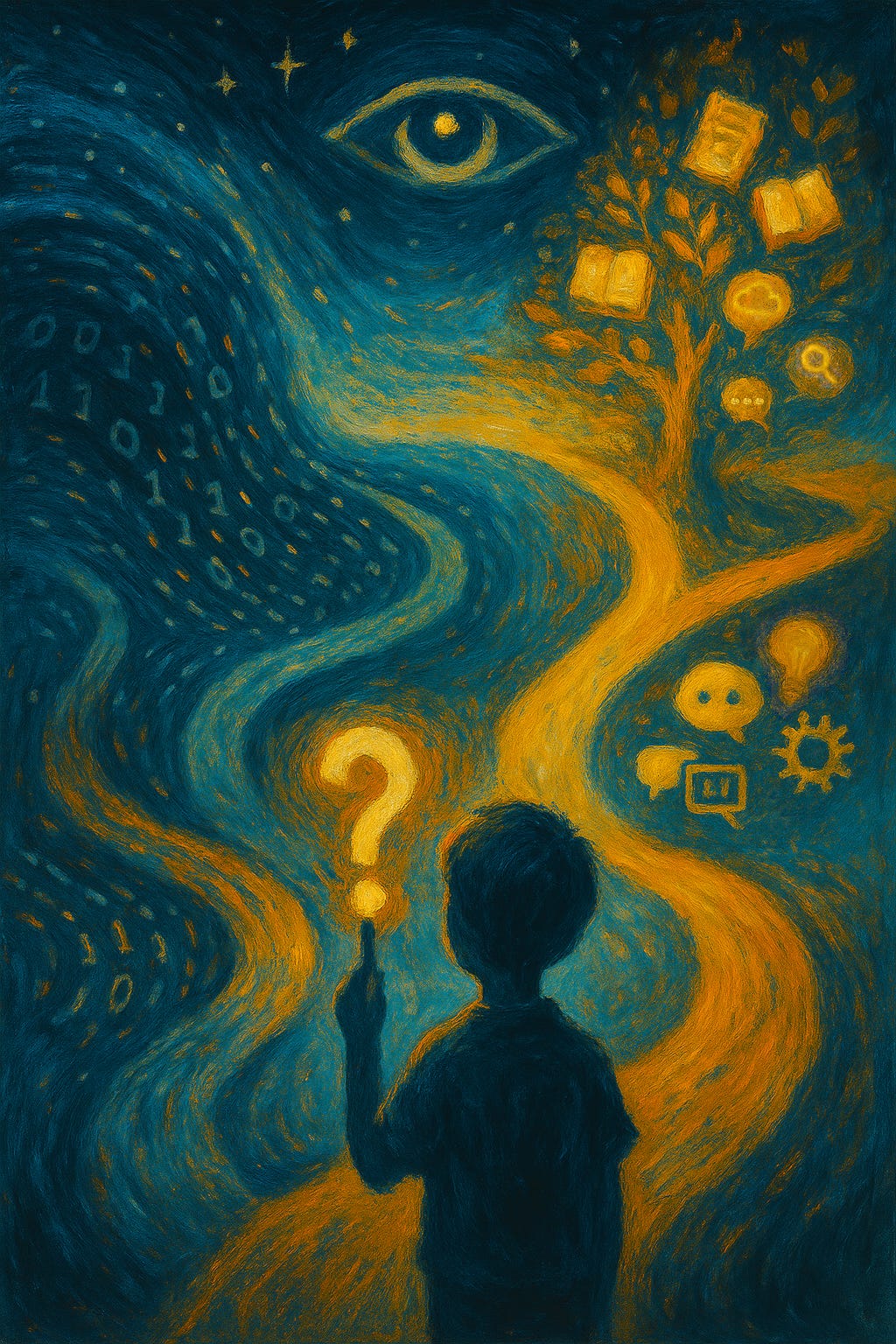
Tomorrow’s best teachers won’t compete with AI. They’ll outdo it where it matters: curiosity, context, compassion. They won’t just prepare kids for the future. They’ll help them shape it, by teaching them how to ask the right questions.
That should be enough to trust that it will be in good hands.
Artwork and editorial work once again courtesy of OpenAI’s GPT-4o.