
When Machines Take the Creative Wheel
What happens when machines outpace us in creativity, not just productivity?

This newsletter started out as an experiment in a new kind of creativity.
Collaborating with a language model that can suggest clever metaphors, smooth transitions, and ideas that sound vaguely wise has changed the game in countless ways. Sometimes it feels like I could take the back seat and just let my virtual partner take the wheel.
There’s a lot to be gained from this new power. It’s sparked ideas I may have never found alone, turning loose ideas into form faster than I ever could. But it also raises the obvious question: what might we be losing in the process?
The Art of Creative Recycling
AI models like the one helping draft this very piece are built to predict and remix patterns based on vast quantities of prior data. So when they mimic something that feels insightful or poetic, it can be easy to dismiss as mere regurgitation. But is human creativity really all that different?
We often talk of creativity with almost mystical reverence. The idea of a lone genius conjuring something wholly original from the void is romantic—but it’s mostly fiction. Almost everything we create is stitched together from fragments of what came before: ideas we've absorbed, stories we've heard, feelings we've tried to make sense of.
That’s how human creativity has always worked. We build on our cultural foundations: copying, mutating and arranging old ideas for new context.
Maybe that’s what makes this technology feel so uncomfortable. It holds up a mirror to the creative process and strips away the magic trick. What we used to call “inspiration” now looks suspiciously like pattern recognition.
Redefining the Creative Edge
Working with AI often feels like stepping into a space with infinite possibilities. Want a dozen variations of a metaphor? A rewrite in the style of Hemingway, Shakespeare, or a pirate? No problem. But without friction, the process risks losing weight—like an aesthetic slot machine, pulling the lever until something feels right.
That’s where constraints matter. Deadlines, structure, limitations—they don’t hinder creativity; they shape it. They push us to make decisions, to commit. Some of the most admired creative works—whether a sonnet, a haiku, or a jazz solo—emerged not in spite of rules, but because of them.
What we risk losing isn’t creativity itself, but the tension that shapes it. The dead ends. The hard decisions. And that’s where the real divide lies: not between human and machine, but between art and content. Content is made to perform. Art exists to connect.
As consumers, we don’t just care about the final product—we care about the person behind it. The voice. The intention. The struggle, even. That sense of human presence is what gives creative work its emotional texture.
We don't just create and consume. We connect.
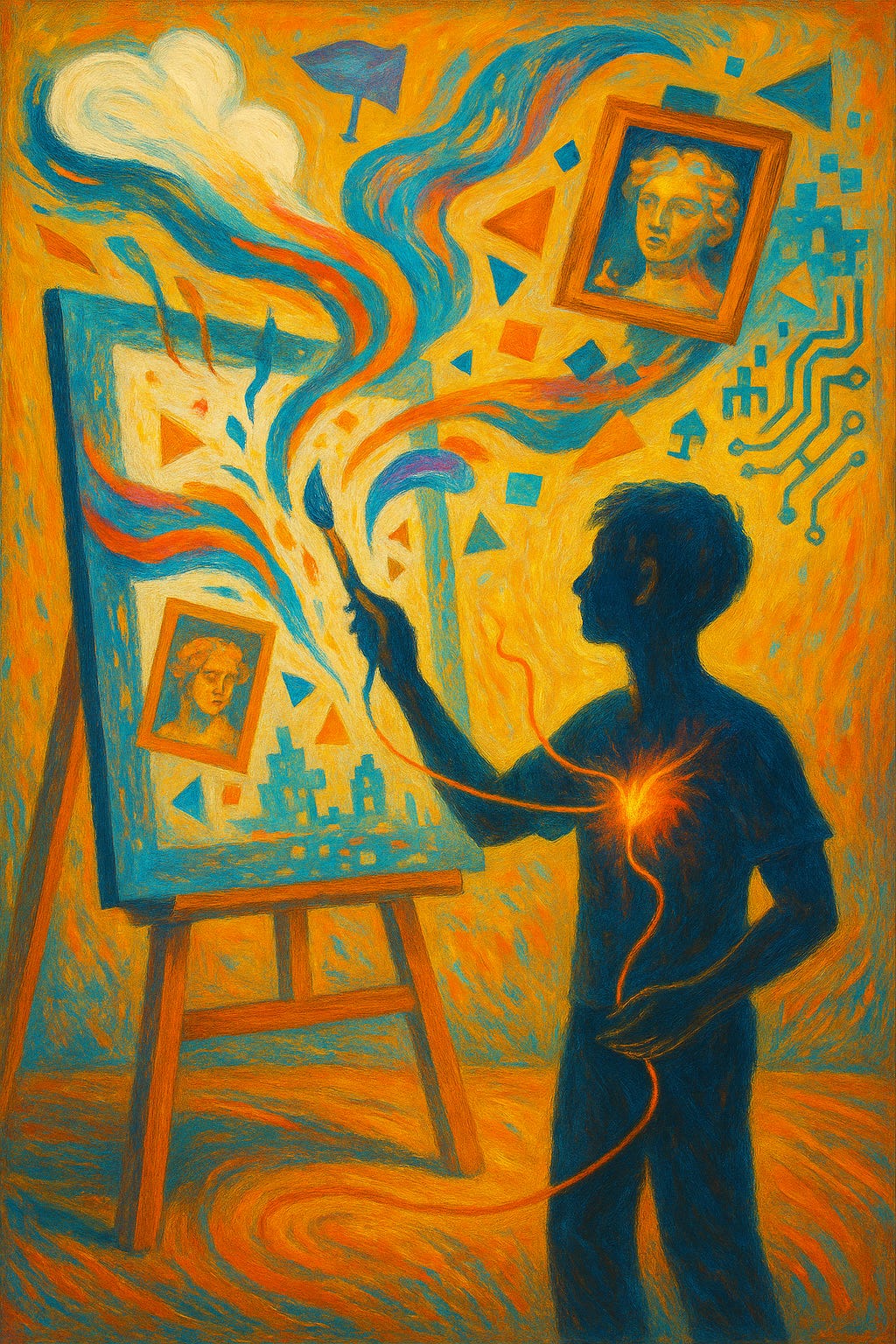
As these tools become more powerful, our role isn’t to outpace them in output. It’s to bring our own judgment. To decide what matters. To hold the emotional thread of a piece. To follow the tension that makes something worth finishing.
Writing with an AI hasn’t made me feel less creative. The tool doesn’t replace my voice; it challenges it, mirrors it, occasionally sharpens it. And sometimes, it surprises me. But the final choice is always mine.
The machine can write the next sentence.
But only I can steer the idea behind it.
Artwork and editorial work once again provided by OpenAI’s talented GPT-4o. Proofreading by Grok 3.